
past: removal
I expect that many of you reading this never attended a school with a cemetery for your classmates, your predecessors, or your lost uncles or aunties. I did not. I was raised in a rural area outside of Victoria, BC, Canada. My playgrounds were forests, streams, and mountains. For my first 9 years of school I was very fortunate to attend schools that valued outdoor learning, play, and exploration in the schools’ private fields, forests, and beaches. Later, when working as an architect with Indigenous clients in remote communities, I learned that I had had the learning experiences that many of them were denied, although these were deeply rooted in their heritage. I was never forcibly removed from my parents and culture and sent hundreds of miles away to be isolated from all that I knew. I had no church overseers who brutalized or raped me, or forced me into harsh manual labor for my school’s profit. None of my schools had cemeteries for my classmates or missing relatives, but as I later learned, several of my friends, colleagues, and clients did.
Removal of young children from their families, communities, and cultures was intentional and with clear purpose: the destruction of relationships that bind each of these together.
General awareness of the historic Indigenous Schools has grown exponentially in recent years with the release of many hundreds (if not thousands) of newly documented unmarked graves of Indigenous students at former residential schools in Canada. None of this is new to Indigenous peoples – for many generations they have lived with the burden of genocide inflicted on them by governments and churches. This century-and-a-half legacy has been officially termed cultural genocide by the Canadian government. Many say it goes beyond the cultural and is better termed as genocide.
Dr. Terry-Lynn Fox:

The protocol for introducing one’s self to other Indigenous people is to provide information about one’s cultural location, so that connection can be made on political, cultural and social grounds and relations established. Therefore: Oki, niistoo’akoka Aapiihkwikomootakii, Miracle Healing Woman. I am Miracle Healing Woman, as my traditional Siksikaitsitapi name details. My English name is Terri-Lynn Fox. My ancestral land I am connected to is the Siksikaitsitapi, or Blackfoot Confederacy. I have four children and six grandsons; my parents are O’taikimakii ki Ihkitsikam. My maternal grandmother, Poonah, was the daughter of Miikskimm, Mary Derouge (Blackfeet and White heritage), and Tatsiiki’poyi (Joe) Iron, who was the son of Ki’somm, Moon. My maternal grandfather, Mookakin, was adopted by Weaselhead. My paternal grandmother, Pi’akii, was the daughter of Morris Many Fingers and Annie Pace. My paternal grandfather, Tsa’tsii, was the son of Stephen Fox and Cecile Charging Woman.
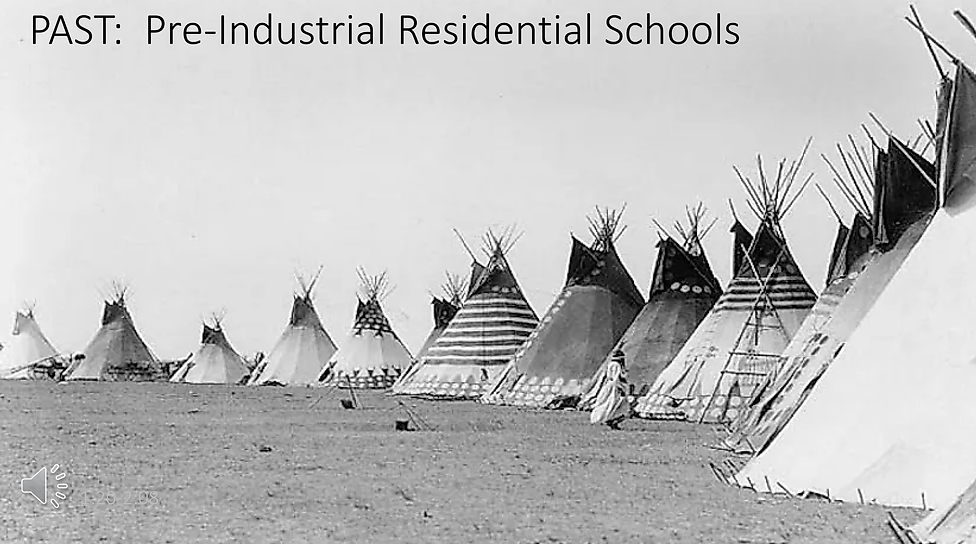
You might think of this cultural web-of-life as being an ethnosphere. And you might define the ethnosphere as being the sum total of all the thoughts, dreams, ideals, myths, intuitions, and inspirations brought into being by the imagination since the dawn of consciousness. The ethnosphere is humanity’s great legacy. It’s a symbol of all that we’ve achieved and the promise of all that we can achieve as the wildly curious and adaptive species we are.

(The Canadian government official responsible for the Indian Residential Schools) Duncan Campbell Scott in 1920 stated, 'Our object is to continue until there is not a single Indian in Canada that has not been absorbed into the body politic and there is no Indian question.' The schools hurt the children. The schools also hurt their families and their communities. Children were deprived of healthy examples of love and respect. The distinct cultures, traditions, languages, and knowledge systems of First Nations, Inuit and Métis peoples were eroded by forced assimilation. The damages inflicted by Residential Schools continue to this day. “We now recognize that it was wrong to separate children from rich and vibrant cultures and traditions and that it created a void in many lives and communities, and we apologize,” said Prime Minister Stephen Harper in 2008. 'These institutions gave rise to abuse or neglect and were inadequately controlled and we apologize for failing to protect you.'

These institutions are total institutions. They alter one’s identity. Indian residential schools are similar to prisons.

Kaamotaan: To overcome; to survive; to recover; reconciliation. We do not inherit the land we walk upon, we borrow it from our children. We are responsible for the seven generations before us, and the seven generations to come after us; our actions span across 14 generations. We are resilient. We will survive.

These schools trace their origins back to the 17th Century in what became the United States. Canada closed its last government-funded and/or operated boarding schools in 1997. Several dozen continue to operate in the USA. The churches ran the schools until the 1970’s in both countries.

The Goal:
These race-based schools were designed to destroy relationships - between family members and all that make up a culture: language, religion, history; to place, and of particular importance to Indigenous peoples, to nature.
In 1887 the US federal government created the system of “Indian Boarding Schools” with the stated goal, in the words of its founder, US Army Captain Richard Henry Pratt, to “kill the Indian, save the man.” Officially, their purpose was “to provide for the U.S. government a method to education and civilize Indian children away from the influences of their savage lifestyle and unchristian ways.” Later, the Canadian official overseeing that country’s “Indian Residential Schools” system, modeled after the USA’s version, labelled it “the final solution to the Indian problem.” The US military also determined that forced assimilation through indoctrination was significantly less costly than physical annihilation. Though largely unstated, the ultimate goal was to wrest control of the land and resources away from the Indigenous peoples and into the hands of the colonizers/settlers.

The Method:
Governments in both countries turned to Christian churches to operate the schools, funded in part by the federal governments. Four church denominations in Canada operated over 140 residential boarding schools in Canada, and 14 denominations operated an estimated 408 schools in the USA. In both countries, the majority were operated by the Catholic Church. The students were taken at a very young age, typically by age seven but not uncommonly much younger, and released at varying ages, typically 15-17. From thousands of hours of testimony, we know that for many, their journey into the system included the following:
-
Forcible removal from home, suddenly, and with threat of arrest by attending police officers for those who tried to hide their children or otherwise tried to stop their forcible removal.
-
Transport hundreds or even thousands of miles away.
-
Many parents had no way of knowing where their children were taken or any means of communicating, except by occasional mail delivery; in later years, infrequent visits granted as special privilege for some.
-
Kids were “welcomed” by having their clothes stripped away, typically to be burned.
-
De-lousing powder, such as DDT, thrown in their face and all over their body.
-
Scrubbed raw in a cold shower.
-
Forced to sleep in dormitories with scores of traumatized children, frequently unheated.
-
Beaten for speaking their only known language.
-
Given “christian” names, and for many, only numbers; documentation includes names assigned by church officials, such as “Dummy bad boy”.
-
Rape, torture, murder.
-
Indentured servitude or slavery.
-
Human trafficking - sale of young children to White people, sight unseen, by priests, through the postal service, for as little as $10 in the 1950’s, with no consultation or notification of the child’s real parents.
-
Babies born to young girls as the product of rape in the schools, thrown live into incinerators.
-
Thrown away
-
Forgotten
Over 160,000 Indigenous kids attended these schools in Canada. Over 6,000 are known to have perished, many anonymously and without return or even notification to their parents. The number of deaths in the US system is less well known but is estimated to be in the tens of thousands. What is known is that in Canada, the death rate of students was higher than for combat soldiers in the Second World War.
These are very harsh words, and hard to believe. But they did continue to operate, until very recently, by those who were charged to be caregivers. I know people who were forced through that system. I’ve worked with them, and for them. Only recently did I learn the horrors of what a friend my age went thru at the hands of the priests who are still being hidden and sheltered by the church who has only recently offered an apology – of sorts - but paired with ongoing legal challenges to legal promises they made to provide financial compensation and to make true efforts toward healing.

Physical Conditions:
Substandard buildings. Overcrowding. Insufficient heat, ventilation. Unsafe:
-
Fire hazards
-
Food
-
Air
-
Water
For the most part, the facilities were not suitable for their climate, frequently their location, and certainly not the community – if there was one nearby – or the culture of those served. For those that were designed with any architectural style, it was Eurocentric; not of the place or culture. The buildings were substandard, overcrowded, with insufficient heat and ventilation. Disease such as tuberculosis was rampant and killed many, as did fire. Food for students was at best substandard; for the priests and nuns, it was plentiful and appealing.
The schools were funded by the federal government and most operated by various churches. There were rarely sufficient funds to feed, house, and educate the students, at least not in a way that would be considered acceptable to non-Indigenous people. This was noted as such by various government officials, including Peter Bryce who resigned in protest and published a book, The Story of a National Crime: Being a Record of the Health Conditions of the Indians of Canada from 1904 to 1921.
Education:
As schools, the systems failed to live up to even their meager promise of providing industrial, agricultural, or domestic service education.
During the Sixties Scoop in Canada (which operated from the 1960’s until the 1980’s), and similarly with the Stolen Generations in Australia, government officials and social workers forcibly removed children from their homes to be adopted in White families instead of providing community resources and support. Families were faced with choosing between adoption or sending their kids to residential schools. Many chose what they could only hope would be less traumatic for their children, adoption and permanent separation from their birth parents and culture into a society they knew would never fully accept them.
After “completion” of their schooling in the boarding schools, the students were discharged. Many never returned to their home communities or families. For those who did, they faced new barriers of trying to re-learn a language they had been forced to forget. They faced family members who were unfamiliar to them. They re-entered communities who for years had no children in them. As young adults, they were frequently faced with becoming parents, yet without healthy experiences, role models, or mentors to guide them.