
present: reconciliation
Since the late 1990’s, there has been significant acknowledgement that many fundamental relationships involving Indigenous peoples are in dire need. This began with the closure of the church and government-run boarding school system in Canada, progressing through the years-long Truth and Reconciliation Commission of Canada, and more recently with the near-explosive public acknowledgement of the brutality of the Indigenous Schools systems and their lasting effects. Similar trends are occurring the US, although government and public acknowledgement is lagging what is occurring in Canada. From familial to community to local-distant governmental relationships, change has begun from levels of funding to granting control to local Indigenous communities and nations, and to re-establishment of traditional Indigenous practices, in schools in both countries.
This process of reconciliation is central to the current era. Since this change has begun in recent decades, there has been an emergence of awareness of the damage that has been done, what needs to be done, and the start of some clear direction and movement. Nowhere is this more evident that in the area of schools - the planning, design, operation , and potentially even more critical, the curriculum and learning practices. It is very much a work in progress with a lot still needing to be done, but the direction away from the dark days of intentional destruction appears clear.

Those who endured the former school systems – and the majority of them are still alive in 2023 – they do not consider themselves graduates or alum of these schools. They are survivors, or victims. For many, the sign of a christian cross on school is a sign of superior education, high morals, hope, even eternal salvation. For millions of Indigenous peoples in North America, and likely elsewhere, it is a symbol of nothing less than brutality, torture, rape, and murder of young kids by priests, nuns, and other church and government officials. The victims number in the tens of thousands. Most survivors are still alive as of 2023.
The trauma of seeing brick schoolhouses, and other structures that remind the survivors of these school systems, is well described in one survivor's memoir. In his book In the Shadow of the Red Brick Building, Raymond Tony Charlie describes how seeing a chimney stack brings back the memory of the incinerator at the school he attended on Kuper Island off the west coast of British Columbia. His memories include the newborn infants who were tossed into the incinerator soon after being born. Their adolescent mothers were students who had been raped by the priests and older students at the school. Stories of newborn babies being burned alive by nuns and those serving as birthing assistants - and the sounds the infants made - are well documented by recollections of many other survivors.

The legacy
It has been nothing short of generational trauma. Sexual abuse, substance abuse, violence, unemployment, poverty, and shortened lifespans. A US government study released in 2022 found that for many survivors, their DNA had been altered by the trauma. It is estimated that as many as 75% of Indigenous students have special needs of one kind or another. Typical government funding is for less than 10% of the general population.


There are presently some 9,000 students in federally-funded Indian boarding schools in the USA, most on or adjacent to reservations and many operated by the local Indigenous peoples. Four such schools are distant from the home communities of most of their students. They are operated by the US Bureau of Indian Education and serve only Indigenous students, many sent by the criminal justice system, some thousands of miles from their home communities – in Oregon, California, South Dakota, and Oklahoma.

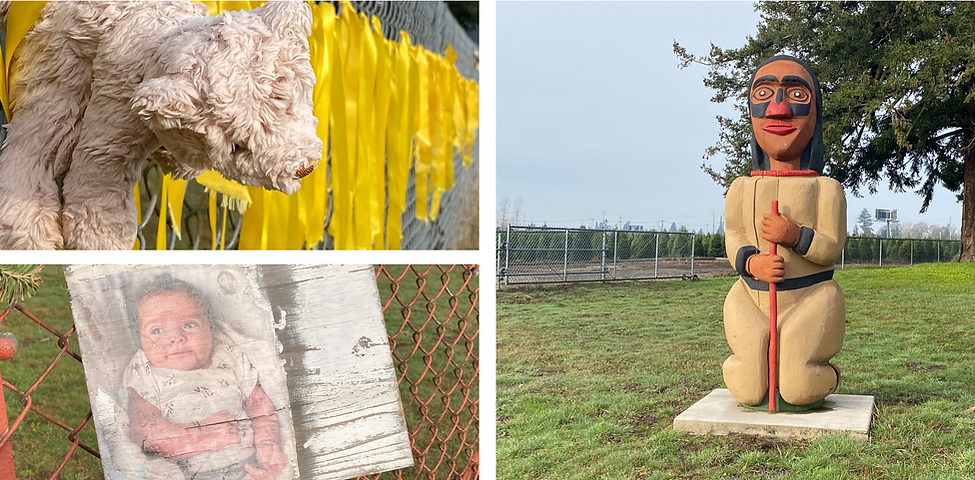
Architecturally, at least two resemble prisons. Chemawa Indian School, located on Indian School Road just north of Salem Oregon, has a still-functioning cemetery for students just outside of the school’s tall security fence. The first recorded findings of perhaps hundreds of unmarked graves of Indigenous students using ground penetrating radar occurred here in 2015. For years it received little to no press outside of a single report on Al Jazeera in 2016. The photos below, of the school's public face, entry, and adjacent cemetary, were taken in 2023 and speak for themselves.


In Alaska, starting in the 1970's, the situation took a much different path, , with great success, in particular with teh Since the Tobeluk v. Lind case and resulting consent decree. Also known as the Molly Hootch Case after the lead plaintiff, it resulted in construction of 105 schools being built in remote communities - in any community with at least 15 students.

At one residential boarding school in Sitka that had been run by churches and the federal government before being shut down, the state took control and established the Mt. Edgecumbe Boarding School. While it is a great distance from many of its students, it is essentially a magnet school where students apply to attend; none are forced to attend. It is highly sought after with over 90% of students being Alaska Native.

In 2007 the Government of Canada launched the Truth and Reconcilliation Commission of Canada. It heard and recorded many thousands of hours of testimony from thousands of survivors. it generated a report in 2015 with 94 specific calls to action which can be found here: https://nctr.ca/records/reports/
As of 2023, just a handful have been implemented.

Efforts to launch a similar commission in the US have been stalled in the Senate for several years. In 2021, after the highly publicized revelations of the unmarked graves found in Kamloops BC, Canada, the US federal government launched a one-year study which released its first report in 2022. It found many of the same things as found in Canada – but they also found epigenetic alterations – generational damage to Indigenous Peoples’ DNA. The study continues.

xx
Soon after US Secretary of the Interior Deb Hagland, the first Indigenous cabinet secretary, announced the start of the study, the US Army announced they had identified 11 remains of students buried in unmarked graves at the former Carlisle Indian School in Pennsylvania, now an active US Army base, and returned them to their home communities. The fur-wrapped bundles in the photo below contain the reamins of the children's bodies.

Since the 1970's takeover of the schools by the US and Canadian governments from the churches, and the gradual phasing out of most by the turn of the century, many other Indigenous community-based and operated schools have been established in Canada and the US. Increasingly, these are being specifically designed with local indigenous input, direction, and control over the facilities and educational programs.
Where many Indigenous communities in Canada and the United States have gained greater control over the planning and design of the schools serving their community, there have been many changes in design of the facilities and the curriculum.
Case Study: Tus-Tuk-EE-SKAWS High School for the Frog Lake First Nation.
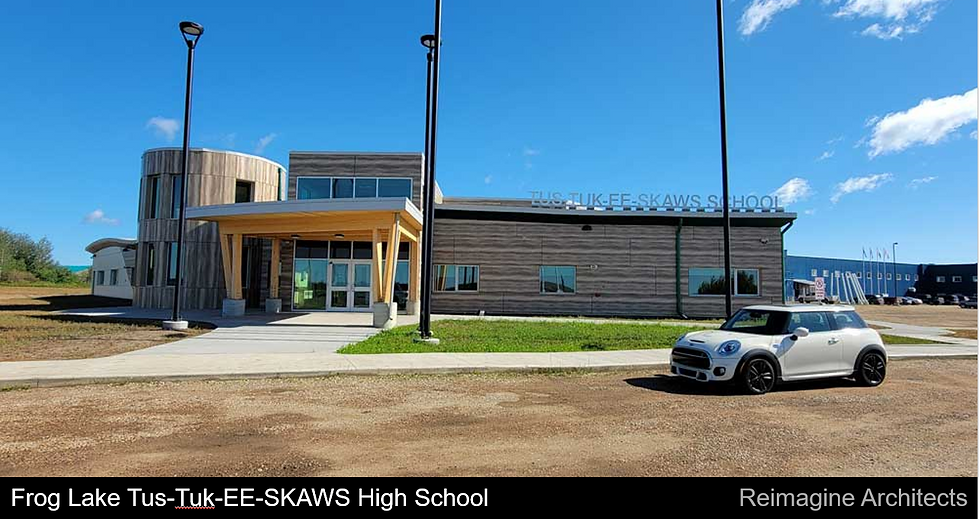
Located in northern Alberta, Canada, the new school and library was designed by Reimagine Architects and completed in 2022. This project, envisioned, planned, and designed in close cooperation and under direction of the Frog Lake First Nation, is an example of emerging trends in schools in Indigenous communities in Canada, and how they incorporate and support Indigenous perspectives and practices. The following are a series of questions posed to Cliffton Cross, Frog Lake First Nations Council Member and Education Portfolio holder, with his replies (given verbally, with very minor edits for clarity):
Why do you think it’s important to have a school within a First Nation?
“It’s important because how better to capture the history of the local area than to provide it in the form of a schoolhouse. Which was promised in the treaty to the people of the treaty territory. Treaty 6 specifically mentioned that we capture all the culture and heritage. Outside the treaty we have access to understanding and empowerment to our members. On reserve, you can capture the teaching of Elders, the teaching of our family members, the teaching of the cultural roots and heritage for generations. You cannot get that outside of our communities. So, First Nations can actually benefit and augment the curriculum based on what they’ve learned, to reinforce the traditional values of an entire people within a structure that is hundreds of years old and refine the thinking of the community.”

What do you think will be the impact of having a new school in your community will have on students?
“It is tenfold. The hope within the community. Right now we’re going through some very trying times - Frog Lake is an oil and gas community and with the 2009 collapse of the oil and gas economy and the 2014 collapse of the economy, we did not have a great outlook. We did not secure ourselves a very bright future when we had the opportunity. This (new school) provided a streamline for hope - the opportunity to develop the capacity within our youth population, to be more valuable to the process to get out of the slump of the economy and reaching out to diversify means of actually providing a quality of life to those individuals and several different generational structures. The new school itself will provide a means of reaching out to their community officials. The school is attached to our arena, to our field house, attached to our administration building. All the leaders are in one place. The youth and elected officials are in one place, to reinvigorate a learning environment that is supposed to be lifelong learning. Within Frog Lake we took the initiative of utilizing the new school as a launching pad of other means of the lifelong learning strategy. Applying the daycare. Applying the library. Applying the Head Start. Applying the Child and Family Services reunification center where we bring families together in a sub-office. All along the same stretch. So we’ve really taken the initiative of taking that traditional knowledge of holistic knowledge and applying it cradle to grave. This is what the new school does.”
What impact do you think the school will have on families?
“It’s again more of a structured base. They are welcome to come in through activities within the school and the library that is within the school, and they can access after-hours program at the fitness center, and after-hours activities that can be a family event. We actually have our monthly pipe ceremonies within the field house. All the grandparents and youth come out and take part in that ceremony once a month. It’s an honouring of what we have looking forward but also recognizing everything we had in the past. The vibrance of adult involvement, that are not school age, will be very prevalent. The fact that we take the radio station and utilize that to reach out to the grandmas who listen to it religiously on Ayik Radio. The home base of that is right adjacent to the school. You can apply the station to a CATS (Center for Academically Talented Students) program where the kids can actually get their voices out to the entire community and reach out to their parents. Again, the pride of the community will be showcased on all levels in every classroom program.”

How do you think the new school will help Elders preserve language and culture?
“The direction came directly from the Elders when we first started planning the school and showcasing that involvement. The fact that we tried to instill all of the directions that the Elders had at the very beginning really empowers them to be involved with it as it’s erected. Imaging the Elders gathering to seeing what the fruits of their labour … have provided to streamline all the ideas into one situation. The open area that provides the four directions, the four seasons, and all the respect that is garnered along the way really takes the family environment and puts it into the building scenario. The Elders themselves will be able to take part not only in the library, but that we made it so the vegetation around the building can be collected as we convey the hunter-gatherer mentality that we’ve all grown up with and has become a part of our heritage. So the trees, the berry-picking, the sap collection, that portion, the environment relays the cultural details of skinning, of smoking meat, of collecting and preserving berries and herbs is all what the Elders wanted us to convey: if we are to teach, we must teach our own way. This is their vision for the school.”

What do you envision for a new First Nation library?
“I believe it must have a holistic vision. If you can take any industrious person and give the opportunity to for that person to ask questions, and have all the answers at their fingertips. For Indigenous people, we don’t get the answers a lot. We get the runaround. If we pose a question, it usually takes a long time for us to get that answer back. But now with the availability of a library in the Nation, I have great hope in the ability for a person to actually reach out and have answers at their fingertips. It was promised to us many, many times. I want to underline one thing. Frog Lake First Nations became (with this community library in the school) the very first First Nation to have a library within the provincial system. So that is a big thing. And it also points to the fact that it was never there before. So, we’re talking about reconciliation. After 150 years of not having a library within a First Nation, really blazing that pathway forward, providing for generations to come, and for generations right now.”
Faye Strong, Accredited Learning Environment Planner
The following is an overview of some of the newer approaches to the design process and outcomes that are being practiced by architects and learning environment planners for schools serving indigenous communities. They vary from community to community, but the following is an overview of many of the approaches to Indigenous education and how schools design can respond and provide support.

Planning for the Whole Child within an Indigenous Learning Environment

Traditonal Pedagogy

Sense of Place

Food Preparation Areas
Traditional Meals

Accessibility & Independence

Supporting Emotional Wellbeing

Psychological Abilities and Wellness

Psychological Abilities and Wellness

Places for Ceremonies and Prayer

Sociological Groupings

Building Student Expertise

The above testimonials and examples indicate a strong trend in school design and curriculum implementation amongst Indigenous communities in North America. The results are derived from the communities and represents their cultures. What can non-Indigenous societies learn from this approach to learning?